 |
 |
|
Women of Ancient Egypt “Not only is the Egyptian climate peculiar to that country and the Nile different in behavior to other rivers, but the Egyptians themselves, in most their manners and customs, exactly reverse the common practices of mankind. For example, the women attend the markets and trade, while the men sit at home and weave at the loom... The women likewise carry burdens upon their shoulders while the men carry them upon their heads… sons need not support their parents unless they chose, but daughters must, where they chose to or not.” Herodotus the Greek historian
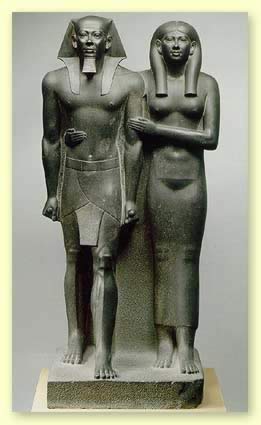
The story of ancient Egypt begins from when the North (Lower Egypt formally called the red crown) and the South (Upper Egypt formally called the white crown) were united as one country under the first Pharaoh Menes. Around 3100 B.C, Menes created the first Dynasty now known as the old Kingdom next to the Nile River with the Capital called Memphis. I do not believe that creating the first Dynasty right next to the Nile River was by chance but by smart planning. Nevertheless, it was the annual Nile inundation which had a profound effect of the development of Egyptian culture. This led Herodotus to state that “Egypt is the gift of the Nile”. Similar to many historic cultures, Egypt society maintained a cast system. At the top of the social pyramid was the Pharaoh. A long way below the Pharaoh in descending order was the upper classes, the educated middle classes, the lower middle classes and the lowest and largest layer of society as like many historic cultures included the private soldiers, servants and peasants. Advancement between the classes was limited for both male and female. Much of the blame can be reverted to the traditional Egyptian method of education and training because parents, more commonly fathers apprenticed their sons in their own trade or professions. So right from birth your career path was known. For young girls, it was automatically assumed that they would marry and have children at a very young age at around 14 since that was consider the age of puberty. When a female reached the age where she begins to menstruate also called her time of purification it signal to everyone that she was ready to bear children. With that being said it is not hard to imagine that the vast population of women was uneducated and untrained in anything other than domestic skills. I would like to point out that no one questioned the uneven distribution of wealth or their place in the caste system because these were the “correct and social divisions….that were necessary to maintain the status quo.” The continuity of their roles as mothers or the continuity of their roles in whatever class they were in was a sign that Egypt and the world was functioning correctly. The bottom line is that an Egyptian woman’s main occupations were marriage, running a household and bearing children. However, Egypt was advance in their attitudes towards women. In ancient Egypt society a woman was “accorded legal rights [under the law] equal to those of a man from the same social class and had the same expectation of a life after death.” The statement in the beginning made by the Greek historian Herodotus was in response to what he had observed in his stay in Egypt in regards to women social and politically freedom. The economic independence that ownership and rights to property gave to the women of ancient Egypt, together with their legal status of being equal with men under the law ensure that they enjoyed a fair amount of freedom. Egyptian women had the right to own property and administer property rights independently from their male counterparts. They were allowed to roam freely without male chaperones. Women could take part in their husband business affairs or better yet conduct their own business affairs. Taking from a papyrus in praise of Isis, the people praise Isis for the equality that women were given “you have made a power for the women equal to that of the men’. Women were also allowed to conduct financial transactions which meant that they held money. More importantly, women had rights to their own children. In other ancient cultures the children were considered part of the father’s lineage and not the mothers. However, there was a breakdown between upper class women and those from the lower classes. One can figure out that women with money lived a much better and easier life than those without. Lower class women mostly peasants lived, breathes and ate domestic tasks. They were seen as the mistress of the house. They were responsible for caring for the children, the cooking, the cleaning, the washing of clothes and the fetching water. The mistress of the house also worked on the field and went to market. Upper class women on the other hand had male servants who took care of the domestic task. For those looking in from the outside it was off the social standing of male and female duties in the household since it was more common for the women to perform the household duties and the men worked on the field. At least to say that the women stayed inside the home while the man goes out and earn his keep. As stated earlier Egyptian women had legal and social rights but they came second to men. Much of the depictions of Egyptian women were in form of literature works, statues or rituals. Women were looked as a passive support to her husband or father. The man was the head of the household. When we examine statues of a man and wife the husband is represented with a large build while the wife is represented with a small frame with her arm around her husband waist or over his shoulder to show that her role was to be one of encouragement and support. I want to comment on the ideal of feminine beauty and their sexuality since it was also represented in many art works. Feminine beauty was a woman who was “graceful and slim, had a small waist and small [but] firm breasts, a long neck, pale skin and blue-black hair.” That is why in Egyptian culture women took pride in making themselves presentable to men. This is also why in many art works a woman’s flesh is creamy yellow. Many contribute the difference in skin color between a man and woman is to show that a woman’s skin was not burnt by the sun due to the fact that she stayed inside the house while the man went out to work. Sexuality was very important because it was connected with birth and fertility and in the afterlife it was connected with creation and rebirth. Motherhood is an important chapter in a woman’s life and more important in ancient Egypt. When a female reached the age where she begins to menstruate also called her time of purification it signal to everyone that she was ready to bear children and she is soon married off. It was the norm to encounter little pregnant girls because she would bear her first child between the ages of 12 and 15. It was also not uncommon to see children without their mothers since one can assume the risk that comes along with child bearing at a young age when a girl’s body is not fully capable of full filling such as great task. Nevertheless, that has not stop young girls from being married off and becoming mothers to multiple children. The more children you had the more social standing in society you had. You were considered a man and had respect from your peers. Sons were considered a blessing and greatly favored because men conducted the burial. The burial ritual was deeply rooted in Egyptian culture and was a must if you wanted to live in the afterlife. If you were not buried properly it was unlikely that you would find your place in the afterlife. Daughters were not favored because one they were not allowed to perform the burial and secondly, a dowry had to be giving to the daughter to take to her husband when she is married off. Daughters were costly especially if you were in the lower classes you did not have money at your disposal to begin with. |
||
